The “Idaho Voice” Newsletter
Idaho Congress of Parents and Teachers celebrate 120 years of Advocating for Children in the State of Idaho.

AI in Idaho Classrooms: What Parents Need to Know
Artificial intelligence is already part of our children’s world and Idaho schools are now working to determine what responsible use of that technology should look like in the classroom. During the 2026 legislative session, Idaho lawmakers passed SB 1227 which directs the Idaho Department of Education to develop a framework addressing AI use in K-12 education. To help make sense of where Idaho is headed, Alexis Morgan, host of The Purple Zone, sat down with Will Goodman for an episode focused on Idaho's AI journey in education.

What Does AI in Idaho Classrooms Actually Look Like?
During the 2026 legislative session, Idaho lawmakers passed Senate Bill 1227, establishing a statewide framework for the use of generative artificial intelligence in K–12 public education. The law directs the Idaho Department of Education, with State Board of Education approval, to develop a framework addressing issues such as human oversight, transparency, safety, data security, academic integrity, accessibility, and responsible student use.
Now, that work is moving from legislation to implementation.
A Conversation Worth Hearing
To help make sense of where Idaho is headed, Alexis Morgan, host of The Purple Zone, sat down with Will Goodman for an episode focused on Idaho's AI journey in education.
Alexis brings a unique perspective to this conversation. She is a PhD candidate in public policy and administration, a former school teacher and school board member, and currently serves as the Director of Public Policy for Idaho PTA. Her experience in the classroom, local school governance, public policy, and parent advocacy gives her a firsthand understanding of the many perspectives that need to be part of this conversation.
Will currently serves as the Director of People and Organizational Services for the Boise School District. Idaho PTA members might recall his engaging workshop, “AI in Education,” at last April’s Idaho PTA Annual Convention. He brings a complementary perspective grounded in education, technology, and public policy. He has also been deeply involved in technology and education work at the state and national levels. Will serves on the board of the Idaho Education Technology Association and is a member of the Idaho State Board of Education's Data Management Council. He also serves as a chairperson on the U.S. Department of Education's National Forum on Education Statistics.
Together, Alexis and Will discuss what happens after legislation is passed and standards are written. Most importantly, they explore what implementation could look like in actual schools and classrooms. They tackle big issues facing schools today: misinformation, data privacy, academic integrity, screen time versus AI, and what should or shouldn’t be automated in the classroom.
Listen to the episode: The Purple Zone — “Idaho’s AI in Education Journey: Guardrails, Implementation, and the ‘Now What?’”
Parents Have a Role in This Conversation
For Idaho families, this is an important conversation because the decisions being made now will shape how our children encounter AI at school. Now is the time to engage.
The Idaho Department of Education has officially opened the public comment period for the proposed K–12 AI Standards. Public comment is open through October 6, 2026.
If you would like to provide feedback, please keep the following in mind:
Submit one form for each comment. If you have feedback on multiple standards, please submit a separate form for each comment.
You will need to include the specific standard number you are commenting on (for example, 3-5.AI.1.1).
K–8 Technology and AI Standards: The Idaho Department of Education is collecting feedback only on the AI portion of these standards. Please reference pages 14–27.
Grades 9–12 AI Standards: The complete set of AI standards is available for review.
2026 Legislative Session Kickoff
A simple guide to staying informed—and getting involved
The Idaho Legislative Session has officially begun! 🎉
This is the time of year when Idaho lawmakers meet in Boise to discuss bills, vote on new laws, and make decisions that can impact families, schools, and communities across our state.
At Idaho PTA, we believe advocacy should feel clear, accessible, and empowering—because every parent, teacher, and community member deserves to understand what’s happening and how to participate.
This guide is here to help you follow the session and stay informed in simple, practical ways.
A simple guide to staying informed—and getting involved
The Idaho Legislative Session has officially begun! 🎉
This is the time of year when Idaho lawmakers meet in Boise to discuss bills, vote on new laws, and make decisions that can impact families, schools, and communities across our state.
At Idaho PTA, we believe advocacy should feel clear, accessible, and empowering—because every parent, teacher, and community member deserves to understand what’s happening and how to participate.
This guide is here to help you follow the session and stay informed in simple, practical ways.
What is the Idaho Legislative Session?
The Idaho Legislative Session is when the Idaho House of Representatives and the Idaho Senate meet to:
Introduce bills (new ideas for laws)
Debate and vote on bills
Make decisions about the state budget
Hear from Idaho citizens and community leaders
If you’ve ever wondered, “How does a bill become a law?” — you can be part of the process when you get involved in local legislation!
How a Bill Becomes a Law (Simple Version)
Here is the basic path a bill usually follows:
A bill idea is written
It is introduced in the House or the Senate
A committee reviews it (a smaller group of lawmakers)
The full House or Senate votes
It moves to the other chamber (House ↔ Senate)
Both chambers must approve it
The Governor signs it or vetoes it
Idaho PTA Day on the Hill — January 20, 2026 🏛️
One of the best ways to learn about Idaho’s legislative process is to experience it in person.
You are invited to join us for Idaho PTA Day on the Hill:
📅 Tuesday, January 20, 2026
🕙 10:00 AM – 4:00 PM
📍 Idaho State Capitol (Boise)
This is your chance to connect with legislators, learn about key issues, and let your voice be heard for Idaho kids.
Why PTA Pays Attention During Session
PTA focuses on issues that affect children and families, including:
Education and school funding
Student safety and mental health
Attendance and learning supports
Technology and online safety
Family engagement and community well-being
Our goal is to stay informed, share clear updates, and advocate effectively.
How YOU Can Stay Informed (Even If You’re Busy)
You don’t have to be an expert. Here are simple ways to stay connected:
✅ 1) Follow Idaho PTA Updates
We’ll share key updates and opportunities for engagement here:
Idaho PTA Advocacy Hub: https://www.idahopta.org/idaho-voice
✅ 2) Track Bills on the Official Idaho Legislature Website
If you want to follow a specific bill number (example: HB123 or SB456), the state’s bill tracker is the most reliable place to start:
Idaho Legislature Bill Tracker: legislature.idaho.gov/sessioninfo/2026
✅ 3) Use Beginner-Friendly Guides
These resources are helpful for understanding what to watch and how the session works:
Idaho EdNews: 2026 Legislative Session Guide
Idaho Capital Sun: 2026 Session 101 Guidebook
Want to Get Involved? Here are 3 Easy Ways
You can support Idaho PTA advocacy by doing any of these:
1) Share your story
Stories help lawmakers understand real life. Even one paragraph matters.
2) Ask questions
It’s okay to say, “I don’t understand this bill—what does it mean for students?”
3) Stay connected and share information
Follow Idaho PTA updates and share them with your local PTA and community.
Idaho & National PTA Resolutions: A Key Tool for Advocacy 🎯
PTA Resolutions are official statements that help guide what PTA supports and advocates for. In Quarter One of 2026, we will review Idaho and National PTA resolutions. Please review them and join us in shaping our advocacy priorities:
https://www.pta.org/home/advocacy/ptas-positions/Individual-PTA-Resolutions
Idaho PTA at the National Table 🇺🇸
As Idaho PTA President, I will be attending the 2026 National PTA Legislative Conference, along with Alexis Morgan, Idaho PTA’s Federal Legislative Chair, to ensure Idaho parent and teacher voices are represented at the national level.
Your Voice Matters
Advocacy doesn’t have to be loud to be powerful. When parents and teachers stay informed, ask questions, and share real stories, it helps leaders make better decisions.
Thank you for showing up for Idaho kids. We are stronger together.
With gratitude,
Jamie Braithwaite
Idaho PTA State President
Idaho Community Schools
Idaho PTA is partners with the Idaho Coalition for Community Schools and holds a seat on one of their steering committees. Community schools aren’t a one-size-fits-all program. They’re an adaptable, locally led strategy, designed by Idaho school districts, parents, and community partners to meet real needs.
Idaho PTA is partners with the Idaho Coalition for Community Schools and holds a seat on one of their steering committees. Community schools aren’t a one-size-fits-all program. They’re an adaptable, locally led strategy, designed by Idaho school districts, parents, and community partners to meet real needs.
In this podcast episode, Alexis explains what the Full-Service Community Schools grant actually is and why the community school strategy works, especially in rural Idaho. She also outlines what was behind the federal decision to end the grant three and half years early that would affect 47 rural and title one public schools impacted.

School Boards 101: The Role, The Questions, The Elections
School Boards 101: The Role, The Questions, The Elections
What voters need to know before heading to the polls in November goes far beyond names on the ballot. In this episode of The Purple Zone podcast, host Alexis Morgan explains the five core governance questions every board member should be able to answer, the decisions school boards make that directly impact Idaho students and families, and why these local elections matter more than ever.
What voters need to know before heading to the polls in November goes far beyond names on the ballot. In this episode of The Purple Zone podcast, host Alexis Morgan explains the five core governance questions every board member should be able to answer, the decisions school boards make that directly impact Idaho students and families, and why these local elections matter more than ever.
Listen now:The Purple Zone Website
Watch on YouTube:The Purple Zone on YouTube
Follow Alexis on social media @the_Idaho_Lady for more highlights and honest thoughts on education and policy in Idaho.
PTA Advocacy in Action: September FLC (Federal Legislative Chair) Webinar Highlights
The National PTA’s September 2025 Federal Legislative Chair (FLC) Webinar brought together state presidents and FLCs nationwide to strengthen advocacy efforts for children and families. Vice President of Advocacy Rose Acerra emphasized the power of collective voices in advancing education policies and thanked leaders for their continued commitment.
Special guest Ryan Betz of the National Farm to School Network highlighted October’s Farm to School Month, underscoring opportunities for PTAs to help ensure every child has access to healthy, nutritious meals while learning about food systems.
Policy updates included PTA’s participation in two new coalitions—the Children Thrive Action Network and Education for All—ongoing advocacy to prevent gun violence, monitoring of FY26 federal funding with concerns about Statewide Family Engagement Center grants, and health guidance updates from the Department of Health and Human Services. With the passage of the BBB Act, states may soon face decisions on opting into a national school voucher program; PTA leaders were urged to collect family stories for advocacy.
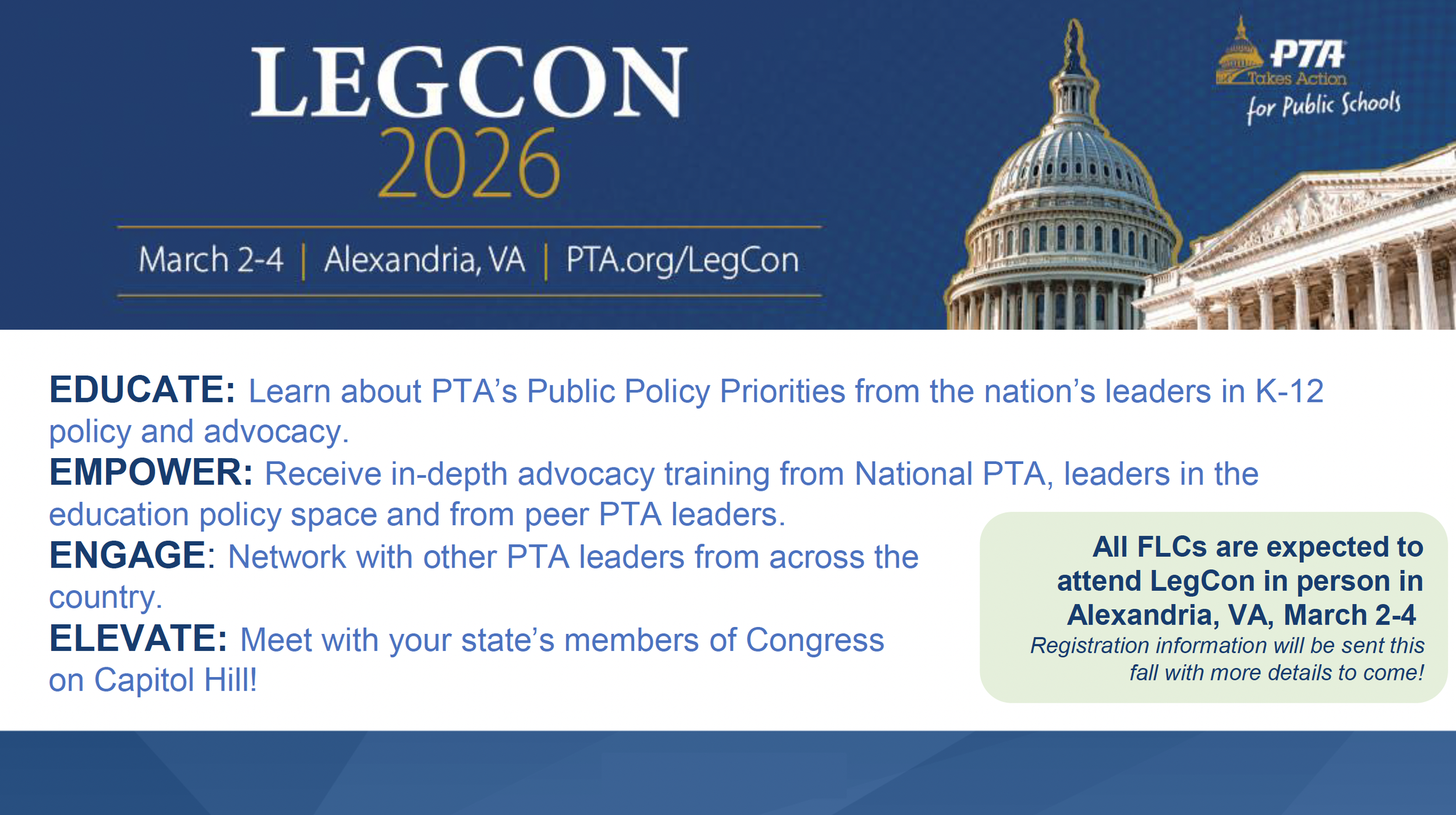
Looking ahead, PTA’s Legislative Conference (LegCon 2026) will be held March 2–4, 2026, in Alexandria, Virginia. Registration opens November 13, 2025. The next FLC webinar is set for November 12, covering vouchers, state legislative activity, and holiday engagement.
By Idaho PTA Leadership | Idaho Voice
On Tuesday evening, National PTA brought together Federal Legislative Chairs (FLCs) and State Presidents from across the country for the September 2025 FLC Webinar. The session spotlighted pressing issues in education policy, celebrated advocacy wins, and outlined critical opportunities for PTA leaders in the months ahead.
Building Momentum Through Advocacy
National PTA Vice President of Advocacy Rose Acerra opened the session with gratitude for the energy, thoughtful questions, and commitment of PTA advocates. “Your time, energy, and commitment to PTA advocacy make a real difference as we work together to advance policies that support every child,” Acerra said.
For those unable to attend, the evening’s agenda included updates on federal education policy, a special presentation on farm-to-school initiatives, and preparation for the upcoming LegCon 2026.
Spotlight: Farm to School Initiatives
Special guest Ryan Betz, Policy Specialist at the National Farm to School Network, shared insights on building a strong and just food system for all students. The Network’s mission is to transform how kids eat, grow, and learn about food in schools and early childhood settings.
With October recognized as Farm to School Month, PTA leaders were encouraged to consider how their states can help ensure every child has access to nutritious meals while learning lifelong lessons about food and health.
Key Policy Updates
National PTA’s Government Affairs staff highlighted several developments:
New Coalitions – PTA has joined the Children Thrive Action Network (CTAN) and Education for All, expanding resources for state and local advocates.
FY26 Federal Funding – Congressional committees are working on the budget package, with concerns about potential discontinuation of Statewide Family Engagement Center (SFEC) grants.
Gun Violence Prevention – PTA continues to push forward with advocacy in line with its School Safety Blueprint.
Children’s Health – Federal actions around health and human services—including recent COVID-19 vaccine guidance—remain a priority for monitoring and parent resources.
School Vouchers – With the passage of the BBB Act, states will soon face decisions about opting into a national voucher program. PTA is encouraging leaders to collect family stories through its School Voucher Story Bank to support strong advocacy against policies that could harm public educationSeptember 2025 FLC Webinar.
Save the Date: LegCon 2026
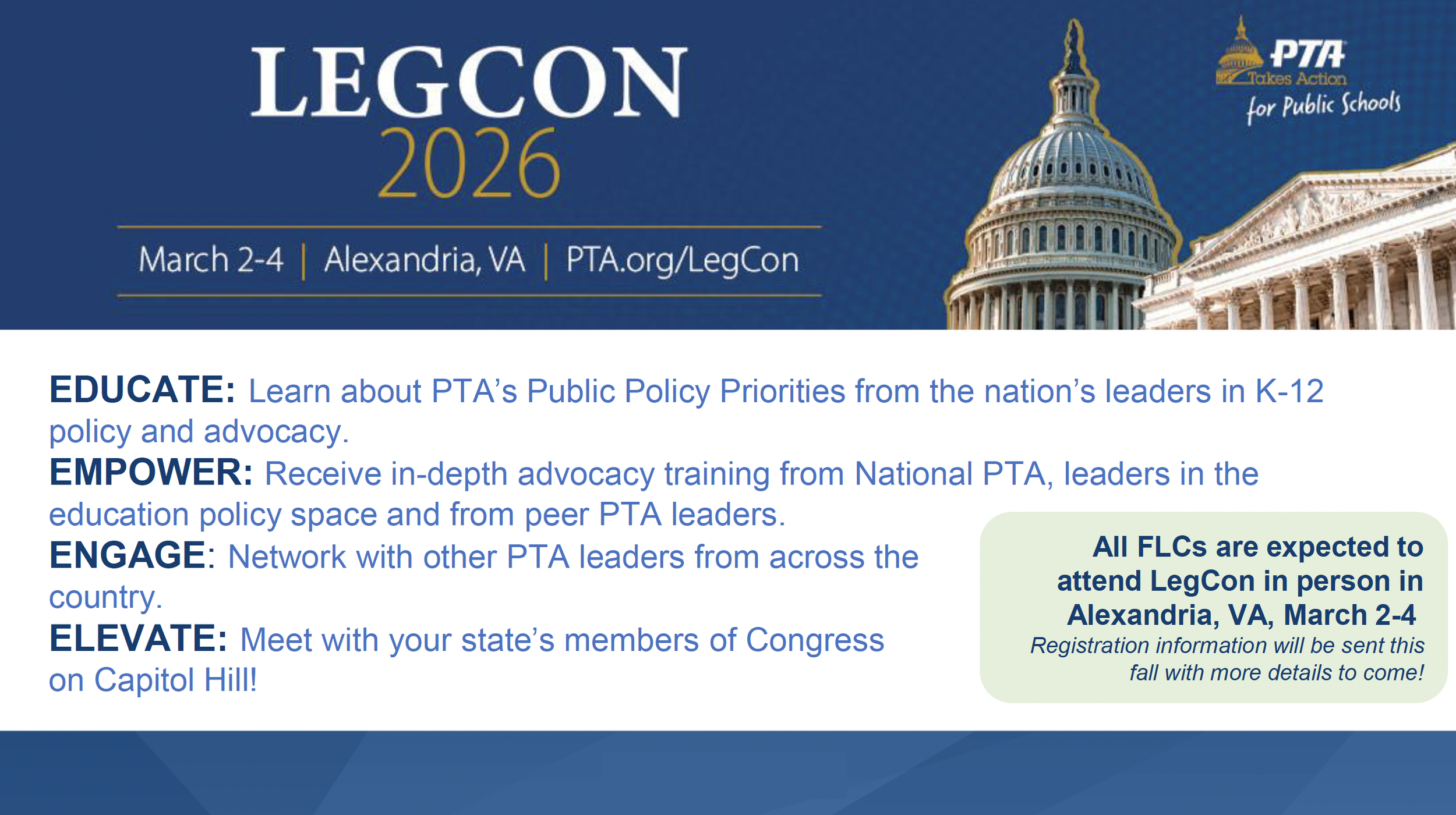
Mark your calendars! National PTA Legislative Conference (LegCon) will be held March 2–4, 2026, in Alexandria, Virginia.
EDUCATE: Learn from national leaders in K–12 education and policy.
EMPOWER: Gain in-depth advocacy training.
ENGAGE: Build networks with PTA leaders from across the country.
ELEVATE: Take PTA’s mission directly to Capitol Hill.
All FLCs are expected to attend in person, with registration opening November 13, 2025
Looking Ahead
The next FLC Webinar will be held on November 12, 2025, at 8:00 p.m. ET. Topics will include state legislative activities, holiday engagement, voucher implementation updates, and preparation for LegCon.
Why It Matters for Idaho
As Idaho PTA members, our advocacy is part of a national movement to ensure every child has access to quality education, healthy meals, and safe school environments. By participating in these initiatives, Idaho families and leaders amplify their voices on Capitol Hill and in statehouses across the nation.
👉 For more information, visit the National PTA Advocacy Page or connect with Idaho PTA leadership to share your advocacy stories.
Idaho PTA 2026 Convention
More details coming soon for the Idaho PTA 2026 Convention!
Register Here: https://www.idahopta.org/events/idaho-pta-convention
More information coming soon!
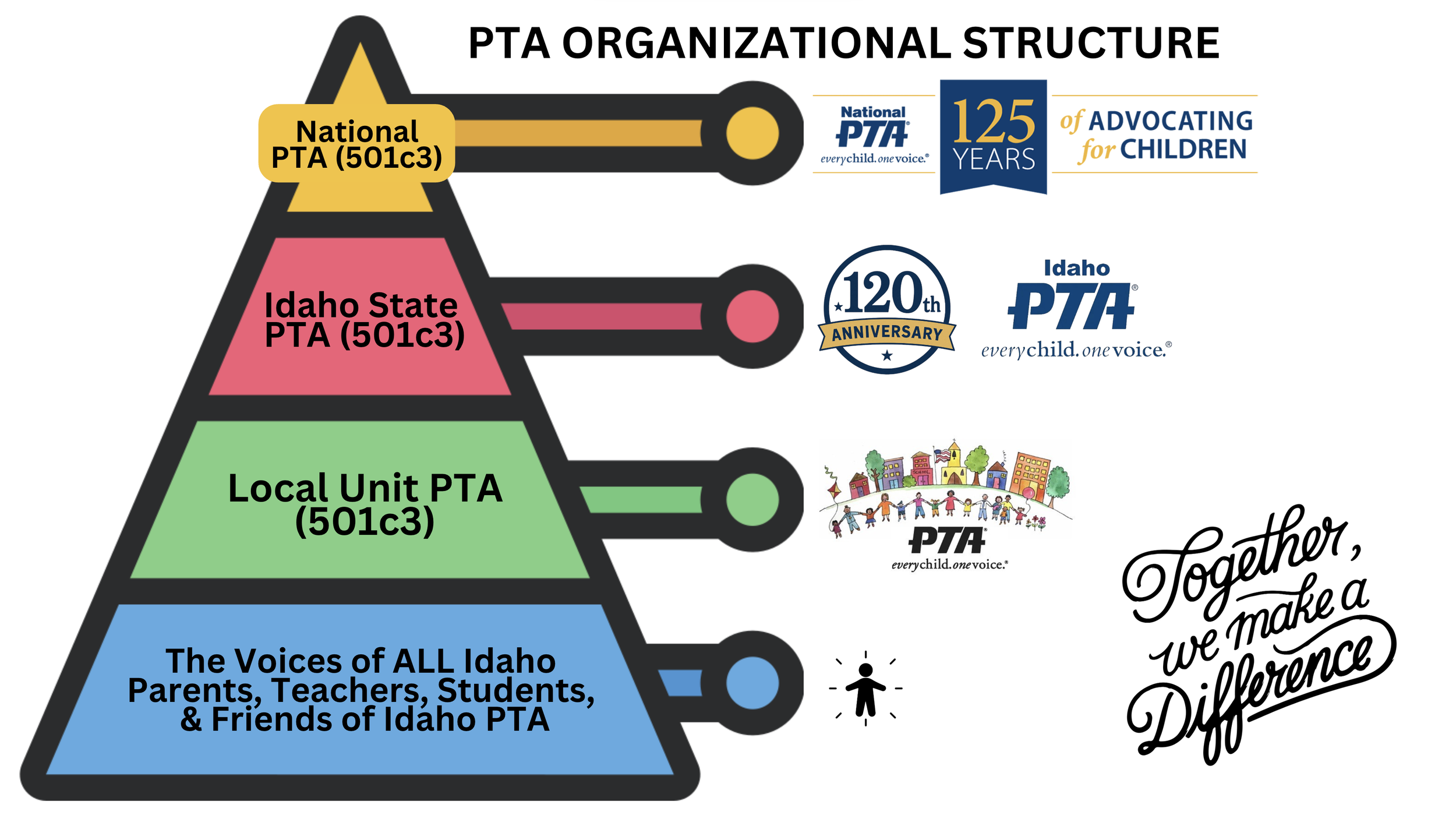
The PTA Organizational Structure
National PTA - 501c3
The National PTA sets the vision and provides national-level advocacy, grants, and program opportunities for states and local units. With over 125 years of service, it offers a unified national voice for children’s rights and education equity.
Role:
Develops nationwide policy and advocacy tools
Supports state and local units with leadership training
Provides access to national programs and funding
Unites millions of PTA voices across the country
Idaho Statewide PTA - 501c3
The Idaho PTA acts as the backbone and connector between local units and the national organization. Celebrating 120 years of service, Idaho PTA provides training, support, compliance tools, and leadership development. It also leads state-level advocacy, legislative tracking, and public policy initiatives to protect and fund public education.
Role:
Offers compliance guidance and nonprofit oversight
Coordinates training, events, and statewide campaigns
Amplifies Idaho’s voice in the national arena
Maintains Non-profit compliance oversight for Idaho local units
Idaho Local Unit PTA - 501c3(s)
These are school-based PTAs, established as nonprofit organizations at the local level. They focus on building community within their own schools, supporting teachers and students directly through events, fundraising, and volunteer efforts. Local Units also receive training, resources, and guidance from the Idaho State PTA.
Role:
Organizes school-specific programs
Elects local leadership
Maintains nonprofit compliance
Connects families to statewide and national efforts
The Voices of ALL Idaho Parents, Teachers, Students & Friends
(Base of the Pyramid – Blue Layer)
This is the foundation of Idaho PTA—where every voice matters. Whether you’re a parent, teacher, student, grandparent, or community supporter, your participation is what drives our mission. You don’t have to belong to a specific school PTA to be part of the movement. Through State-wide Membership or as a Friend of Idaho PTA, your involvement fuels advocacy, education, and support for all children across Idaho.
Role:
Voices of all Idaho kids and public schools
Participates in events, training, and legislative efforts
Supports PTA values and mission
🧭 Together, We Make a Difference
From the home, classroom, county to the Capitol, Idaho PTA’s membership model ensures that every voice is heard—from the grassroots up to the national stage. Whether you're joining individually, through a school, or as a community partner, there’s a place for you in this movement.
National PTA - 501c3
The National PTA sets the vision and provides national-level advocacy, grants, and program opportunities for states and local units. With over 125 years of service, it offers a unified national voice for children’s rights and education equity.
Role:
Develops nationwide policy and advocacy tools
Supports state and local units with leadership training
Provides access to national programs and funding
Unites millions of PTA voices across the country
Idaho Statewide PTA - 501c3
The Idaho PTA acts as the backbone and connector between local units and the national organization. Celebrating 120 years of service, Idaho PTA provides training, support, compliance tools, and leadership development. It also leads state-level advocacy, legislative tracking, and public policy initiatives to protect and fund public education.
Role:
Offers compliance guidance and nonprofit oversight
Coordinates training, events, and statewide campaigns
Amplifies Idaho’s voice in the national arena
Maintains Non-profit compliance oversight for Idaho local units
Idaho Local Unit PTA - 501c3(s)
These are school-based PTAs, established as nonprofit organizations at the local level. They focus on building community within their own schools, supporting teachers and students directly through events, fundraising, and volunteer efforts. Local Units also receive training, resources, and guidance from the Idaho State PTA.
Role:
Organizes school-specific programs
Elects local leadership
Maintains nonprofit compliance
Connects families to statewide and national efforts
The Voices of ALL Idaho Parents, Teachers, Students & Friends
(Base of the Pyramid – Blue Layer)
This is the foundation of Idaho PTA—where every voice matters. Whether you’re a parent, teacher, student, grandparent, or community supporter, your participation is what drives our mission. You don’t have to belong to a specific school PTA to be part of the movement. Through State-wide Membership or as a Friend of Idaho PTA, your involvement fuels advocacy, education, and support for all children across Idaho.
Role:
Voices of all Idaho kids and public schools
Participates in events, training, and legislative efforts
Supports PTA values and mission
Community Conversation: Idaho Falls Town Hall
Building Trust and Credibility in Our Communities
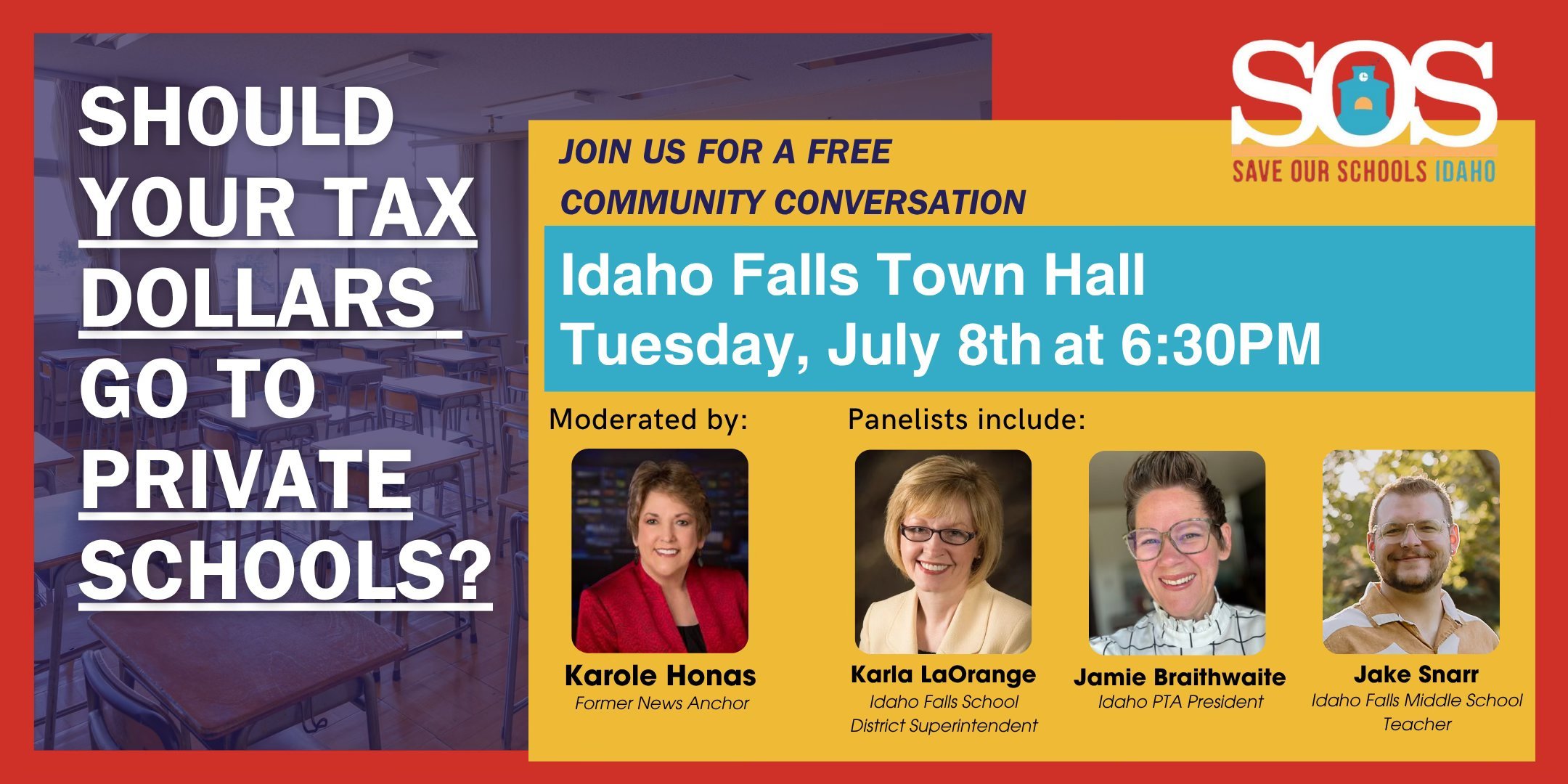
At the recent Save Our Schools Town Hall in Idaho Falls, someone in the audience asked me a question that cuts to the heart of this debate:
“This bill allocates only 0.89% of the general fund budget. Our state has not provided funds to properly support schools ever. This bill is creating a forum to discuss the best interest of Idaho kids, but how are you addressing building trust and credibility within our communities to garner the support needed to move the mark here in our community? This room supports public education, but what are you doing to build trust and support within this community?”
This is exactly the right question. It’s not just about the money. It’s about trust.
When money is diverted off the top of the state budget to private schools, without public debate or legislative appropriation, it fuels mistrust in how decisions are made. Communities rightly ask:
Who decides how public money is spent?
Are those decisions transparent and accountable?
Will every child, especially the most vulnerable, be served?
By Jamie Braithwaite, Idaho State PTA President
As a mother of seven, an Idahoan, and President of the Idaho State PTA, I believe fiercely in the transformative power of public education. For 120 years, Idaho PTA has worked to ensure every child can reach their full potential, regardless of ability, income, or background.
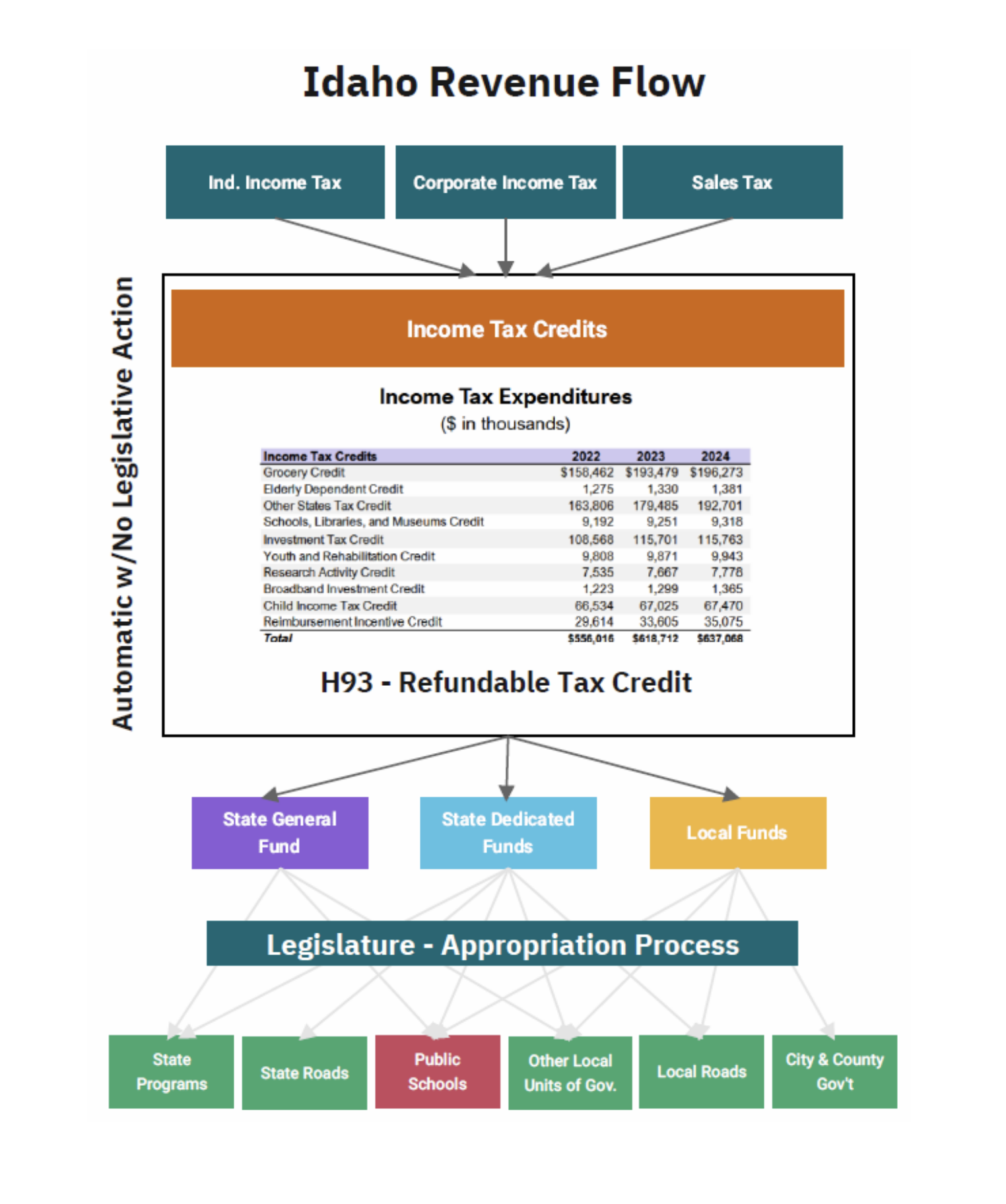
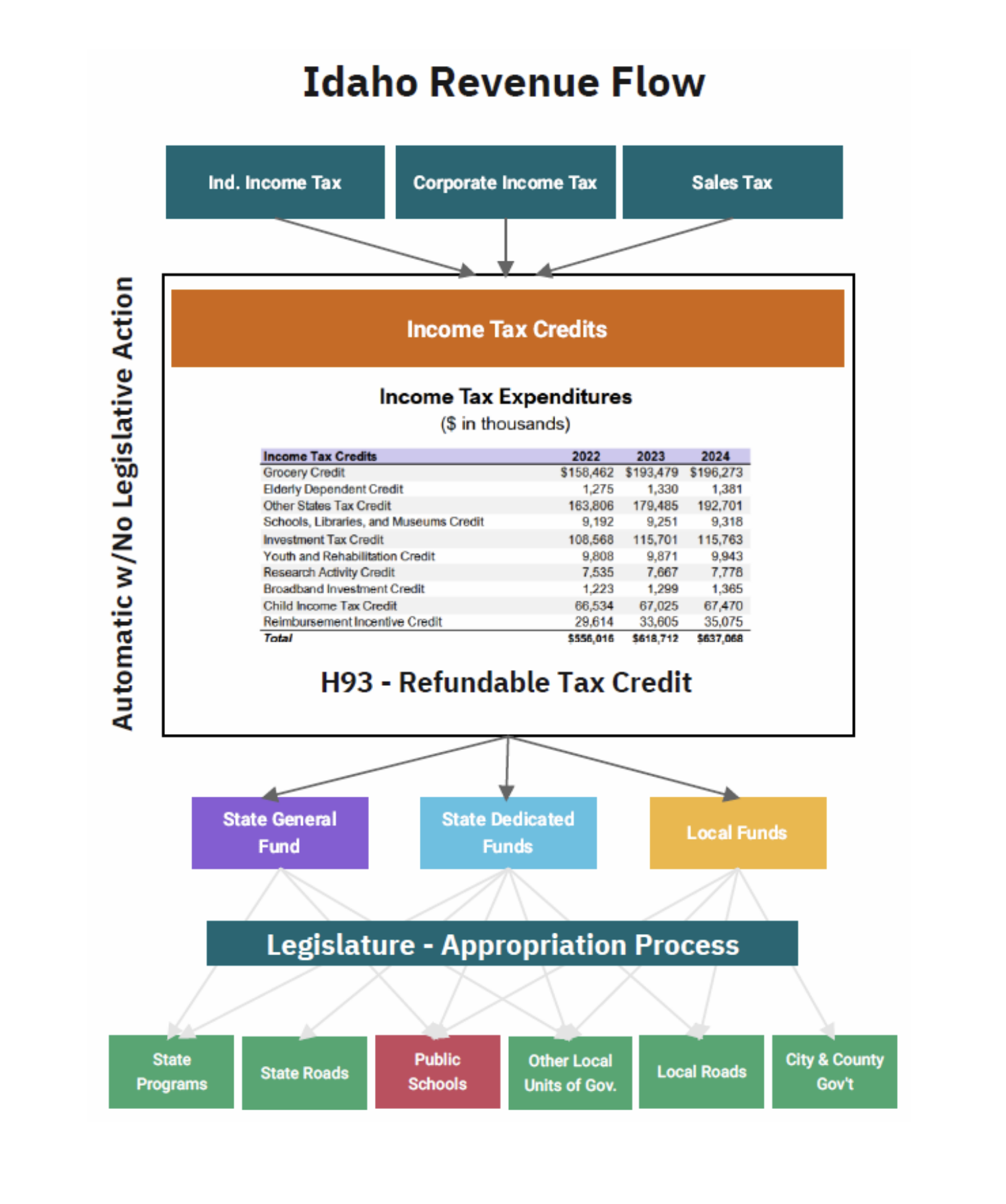
Today, that vision faces an urgent challenge because House Bill 93 (HB93) has already passed—and is diverting millions of public dollars to private schools with little transparency or accountability.
Building Trust and Credibility in Our Communities
At the recent Save Our Schools Town Hall in Idaho Falls, someone in the audience asked me a question that cuts to the heart of this debate:
“This bill allocates only 0.89% of the general fund budget. Our state has not provided funds to properly support schools ever. This bill is creating a forum to discuss the best interest of Idaho kids, but how are you addressing building trust and credibility within our communities to garner the support needed to move the mark here in our community? This room supports public education, but what are you doing to build trust and support within this community?”
This is exactly the right question. It’s not just about the money. It’s about trust.
When money is diverted off the top of the state budget to private schools, without public debate or legislative appropriation, it fuels mistrust in how decisions are made. Communities rightly ask:
Who decides how public money is spent?
Are those decisions transparent and accountable?
Will every child, especially the most vulnerable, be served?
How We Build Trust
As Idaho PTA President—and as a mother, neighbor, and community member—I’m focused on building trust in three practical ways:
Listening First.
We’re hosting conversations across Idaho to hear parents’ and teachers’ concerns. Real trust grows when people feel heard, not lectured. Parents want to know: “Will my school stay open? Will my child’s teacher have what they need to teach effectively?” We have to listen before we lead.
Sharing Facts, Not Fear.
Misinformation erodes credibility. For example, many Idahoans don’t realize that we already have nine public school choice options—and that HB93 doesn’t create new choices, but simply shifts who pays the bill. We’re working hard to share accurate, accessible information so families can make informed decisions.
Advocating for All Children, Not Just Some.
Our message is simple: public dollars should serve the entire public. Private schools have their place, but they cannot replace public schools, which must accept and educate every child. By emphasizing equity and fairness, we show Idahoans that we’re advocating not just for “our own kids,” but for every child.
The Path Forward
Idaho has historically underfunded education. Our public schools have stretched every dollar to serve a growing, diverse population of learners. But real progress will come only when communities trust that the system is:
Transparent
Accountable
Designed to serve every child, not just a few
I believe the path forward lies in keeping the conversation going. HB93 has sparked passionate debate, but we must move beyond debate to solutions that strengthen—not divide—our communities.
We build trust when we stand together for the principle that public dollars should remain in public schools to serve all Idaho kids. I’m committed to doing this work, shoulder to shoulder with parents, teachers, and community leaders.
What Idahoans Can Do
HB93 has already passed and is reshaping Idaho’s education funding. If you care about Idaho’s future, here’s how you can help:
Learn how your lawmakers voted on HB93.
Sign the “Not A Dollar More” petition.
Talk with friends and neighbors about the facts.
Contact your legislators and urge them to protect public schools.
Public dollars should serve the entire public. Our kids, our teachers, and our communities deserve nothing less.
HB93 Isn’t About New Choices
Supporters of HB93 often frame it as a win for “school choice.” But let’s be clear: Idaho already offers robust school choice. Families here enjoy nine publicly funded options, including neighborhood schools, open enrollment, magnet schools, charter schools, online virtual programs, dual enrollment / advanced opportunities, alternative schools, homeschool, and private school.
My own seven children have experienced nearly all of these pathways. Choice is alive and well in Idaho. HB93 did not create new choices—it simply shifted who pays the bill.
Under HB93, private educational expenses are now subsidized by public tax dollars. Yet private schools are not required to serve all students, particularly those with special needs, English language learners, students with behavioral challenges, or low income families who often lack a strong voice at the table.
The Threat of Further Expansion
$50 million is already diverted— voucher advocates are already pushing to expand HB93 to $150 million or more. Meanwhile, Governor Little has warned of statewide budget cuts of 4% to 6% to core services like public education.
Public schools are being forced to do more with less, while HB93’s tax credits remain protected from cuts. This creates a system where public schools bear the financial burden, even as private institutions benefit from new taxpayer subsidies.
Protecting Idaho’s Promise
Our Constitution makes Idaho’s duty clear: to maintain a “general, uniform and thorough” system of free public schools. When public funds are diverted before the legislative appropriation process, we weaken that promise—and risk leaving our most vulnerable students behind.
Private schools have a valuable place in our communities, especially religious and mission-based institutions. But private school is a private choice. It cannot come at the cost of undermining the public system that serves all Idaho’s children.
Jamie Braithwaite is the Idaho State PTA President. She holds an Executive MBA from the Quantic School of Business and Technology and an undergraduate degree from Brigham Young University in Technology and Engineering Education. She and her husband, Garth, have raised seven children in Idaho Falls, experiencing nearly every educational option Idaho offers. Jamie is a passionate advocate for families, public education, and community engagement.

Imagine Excellence: Idaho Grassroots Education Movement
Idaho PTA is participating in a grassroots approach with the creation of the Idaho Public Education Coalition. Legislators and educators will return to their communities, ask real questions, and listen. We’ll gather that input through a statewide survey available in May and regional meetings with parents, educators, students, administrators, and other community members. This data will provide the critical foundation for future policy.
Interested in attending our Imagine Excellence meetings in your community? Read more: https://idahoed.com
Jamie Braithwaite, Idaho State PTA President participated in the Imagine Excellence Meeting in Eastern Idaho on June 16, 2025. She discussed the future of Idaho Public Education along side legislators, school board members, school administrators, superintendants, teachers, parents, and community members.
“If I had to start with one change, it would be this: Our kids. Our schools.
Our kids aren’t the problem—the system is. Let’s stop asking them to fit into outdated models, and start building schools for the future—schools that recognize and nurture every student’s full potential.” - Jamie Braithwaite
Read More for Jamie Braithwaite’s answers to all the questions
It’s Time to Start a Serious Discussion About the Future of Public Education in Idaho.
Idaho PTA is participating in a grassroots approach with the creation of the Idaho Public Education Coalition. Legislators and educators will return to their communities, ask real questions, and listen. We’ll gather that input through a statewide survey available in May and regional meetings with parents, educators, students, administrators, and other community members. This data will provide the critical foundation for future policy.
Interested in attending our Imagine Excellence meetings in your community? Read more: https://idahoed.com
Jamie Braithwaite, Idaho State PTA President participated in the Imagine Excellence Meeting in Eastern Idaho on June 16, 2025. She discussed the future of Idaho Public Education along side legislators, school board members, school administrators, superintendants, teachers, parents, and community members.
“If I had to start with one change, it would be this: Our kids. Our schools.
Our kids aren’t the problem—the system is. Let’s stop asking them to fit into outdated models, and start building schools for the future—schools that recognize and nurture every student’s full potential.” - Jamie Braithwaite

Read Below for Jamie Braithwaite’s answers to all the questions:
Our kids. Our schools.
What would it look like if we could rebuild Idaho’s public education system from the ground up without direct regard for funding, regulations, or tradition?
As the Idaho PTA President, I hear from parents and teachers all over the state of Idaho: ‘We’re too busy, too burned out, too unheard. And when we do show up, it’s never enough. The job gets harder every year.’
The truth is—the current system isn’t working.
And when we talk about rebuilding trust and re-engaging families, we don’t have a perfect answer. But what I do know is this: connection is the starting point.
We need schools that feel like community hubs—not just drop-off zones. Families and communities must be seen as co-creators, not just spectators. And students need to experience belonging before they’re expected to achieve. District Leadership and School Administrators need to include teachers and parents in training and focus areas for the schools.
I don’t have the answer. But I believe it starts with rebuilding trust—trust in our kids, and trust in our school communities.
If you could prioritize three changes for Idaho education, what would they be?
If I could narrow it to just three, I would—but the truth is, our system needs a comprehensive shift. What I can say is this: the families of Idaho aren’t asking for more bells and whistles. They’re asking for belonging, purpose, and potential.
The changes we need aren’t surface-level—they’re structural, cultural, and relational. We need to:
Rebuild trust between families, schools, and communities
Redefine success to include emotional safety, creativity, and real-world readiness
Reimagine the role of educators as mentors—not just content deliverers
Reconnect schools with communities—through project-based learning, business partnerships, and strengths-based mentorship
Remove systemic barriers that make flexibility, innovation, and individualized learning feel impossible. Avoid sabotaging schools that are working in the modern world.
If I had to start with one change, it would be this: Our kids. Our schools.
Our kids aren’t the problem—the system is. Let’s stop asking them to fit into outdated models, and start building schools for the future—schools that recognize and nurture every student’s full potential.
I don’t have all the answers—but I’m here to co-create them with anyone who’s ready to imagine something better for Idaho’s kids.
What would you consider the primary purpose(s) of our Idaho Public Education System?
The 120-year-old mission of the Idaho PTA is to make every child’s potential a reality—by engaging and empowering families and communities to advocate for all children. That mission must guide the purpose of public education in Idaho.
The goal isn’t just to produce graduates. It’s to ignite minds, expand opportunity, and help every child discover who they are and what they can become.
I think of what one Idaho mom recently told me. She said: “Grades are only important because they’re the vehicle to opportunity. But if my son isn’t stimulated—if he’s not seen, challenged, or inspired—he shuts down. He might be brilliant, but without the right system, he’s at risk of becoming a shell of unfulfilled potential.”
That’s the urgency we’re facing. Public education must do more than deliver curriculum. It must:
Connect families and schools as partners
Create equitable access to STEAM, creativity, and real-world experiences
Foster emotional safety, curiosity, and confidence
In short: the purpose of Idaho’s public education system should be to uncover potential, remove barriers, and prepare every child not just to pass—but to thrive.
And with that said, we also can’t keep ignoring the deep, urgent impact of extreme student behavior in our schools. Something must be done for the 1% of students in every building who—due to trauma, emotional disturbance, or lack of boundaries—disrupt learning for everyone else. I’ve seen teachers cussed out, chairs thrown, and educators verbally abused by both students and parents.
We must uphold the rights of every student to learn in a safe and focused environment. A student’s choice to misbehave should never take precedence over other students’ rights to learn.
Too often, IEP protections and bureaucratic distance prevent swift, supportive action—and inexperienced principals may feel unequipped or afraid to intervene.
This isn’t just a behavior issue—it’s a burnout issue. It’s a trust issue. And it’s a justice issue.
If we truly want every child to thrive, we have to create systems that protect learning—for all children.
What would it look like if we could rebuild Idaho’s education system from the ground up without direct regard for funding, regulations, or tradition?
Our families want more than test prep. They want purpose. And in Idaho, purpose looks like preparing students to serve and thrive in the communities where they live.
We have the Idaho National Lab in our backyard. We have world-class healthcare providers, skilled tradespeople, and entrepreneurs across every corner of this state. Imagine if students didn’t just read about energy—they helped solve energy challenges with INL mentors. If they didn’t just learn about anatomy—but shadowed nurses, EMTs, or physical therapists at EIRMC.
The barrier? Lecture-Based Learning & Out-Dated Assessment Models.
Our kids are craving action. We need to shift from content delivery to mentorship—where educators guide real experiences, and students build confidence through doing.
The PTA believes hands-on learning is not a luxury—it’s a necessity. The people doing the work turn into the people doing the learning. We envision schools where real-world partnerships are baked into the calendar. Where every student graduates not just with credits, but with clarity—about who they are, what they’re good at, and where they’re headed.
If every student had a personalized education plan based on their passions, strengths, and career goals, how would that change the way we teach, mentor, and prepare them for the future?
If every Idaho student had a personalized plan, we’d see a seismic shift—not just in outcomes, but in how school feels.
These plans would begin in 6th grade—student-driven, family-supported, tech-enabled—and designed in partnership with teachers, counselors, and the broader community.
Teachers wouldn’t be stuck delivering one-size-fits-all content. They’d be engaged in every child’s story, building relationships that help unlock purpose and potential. But this shift requires training and leadership from administration. It demands time to plan and provide feedback. It demands a move away from fixed mindsets—lecture, test, grade—to growth mindsets that prioritize discovery, feedback, and mentorship.
When students are engaged, learning becomes exponential. They’re no longer asking, ‘Why am I learning this?’—they’re asking, ‘What can I do with this?’
Geoff Woods, author of Ai-Driven Leader emphasizes that we must stop thinking of AI as an assistant or administrator—and start seeing it as a strategic thought partner that enhances thinking, decision‑making, and problem‑solving. He reminds us that the U.S. education system was designed in the early 1900s—built to serve industrialists like Rockefeller, not the students of today. In a world now shaped by AI, we don’t need schools that teach students to repeat information—we need schools that teach them to think, question, problem-solve, create, and lead. Students with these skills can do anything!
AI should be used to enhance their thinking—not replace it. And in this new reality, students must be prepared to remain the thought leaders in an AI-driven society—equipped to problem-solve, innovate, and make ethical decisions that technology alone cannot.
That’s the future we should be preparing them for.
How could Idaho’s businesses, parents, and community organizations work alongside educators to create a more dynamic, relevant, and opportunity-driven education system? What partnerships could redefine educational outcomes?
At Sunnyside Elementary, I created Family STEAM Night—a partnership event that ran from 2015 to 2020 with the Sunnyside PTO. Every student came to school dressed as their future career and presented to their peers. Every classroom hosted a local business offering a real-life, hands-on experience in Science, Technology, Engineering, Art, or Math.
We had oranges getting sutured by a local surgeon, cow eyes explored by an optometrist, bones being drilled by orthopedic surgeons, INL robots navigating obstacle courses, Idaho Falls Fiber lines handled by engineers, and car tires drilled by an automotive technician. Art, medicine, robotics, and trades all came alive in two-minute bursts of inspiration.
Families engaged—because their students were the stars. Businesses showed up—because it was joyful, purposeful, and full of future leaders. The family evening worked because it was relational, hands-on, and student-centered.
So the real question isn’t just ‘What partnerships do we need?’ It’s: How do we build a system and culture that makes these kinds of experiences the norm—not the exception?
How do we create schools that are community hubs, not closed loops?
How do we invite business owners, artists, engineers, and farmers into our classrooms—not just as guests, but as co-educators?
Idaho is creating incredible career-technical education opportunities expanding across the state! We don’t have every answer—but Idaho PTA is committed to building this bridge. And we believe this is how we redefine outcomes: not just by raising test scores, but by raising community connection.
What if learning wasn’t tied to a classroom, a grade level, or a strict schedule? Could we design an education system that allows students to learn at their own pace, in their own way, and from a variety of settings?
Project-based learning is one of the most powerful ways to take learning beyond the classroom. It connects students to something bigger than themselves and their family—to their community, their passions, and the real world.
But right now, we’re asking teachers to innovate inside a system that wasn’t built for flexibility. We expect individualized learning without structural change. The truth is—our teachers are overworked, our administrators are overwhelmed, and our systems are rigid.
If we want students to learn at their own pace, in their own way, and across a variety of settings, we have to rebuild the system around trust, mastery, and meaningful engagement. That’s exactly what Robert Marzano outlines in the High Reliability Schools framework:
A safe, collaborative culture (Level 1)
Effective teaching with continuous support (Level 2)
Clear, guaranteed access to relevant curriculum (Level 3)
Standards-based reporting that reflects real growth (Level 4)
Competency-based education—where students progress when they’re ready, not when the calendar says so (Level 5)
This framework helps us redefine what success even looks like.
It’s no longer just about test scores or grade levels. It’s about helping students build confidence, explore their strengths, engage in real-world projects, and step into adulthood with a sense of purpose.
But this can’t fall on teachers alone. We must invest in building-level professionals—value them, compensate them, train them, and stop micromanaging them. District offices should serve the schools, not the other way around.
I don’t have the full answer. But that’s the point.
We need to figure this out—together.
And Idaho has a chance to lead the way.
Imagine schools focused on real-world experience rather than standardized tests—what hands-on learning opportunities, apprenticeships, or community-based projects would you want to see for Idaho students?
🧪 1. Skills to Feed Into the Idaho National Laboratory (INL):
STEM foundations: Math, chemistry, physics, biology
Systems thinking: Understanding complex, interconnected systems
Critical thinking & problem solving
Cybersecurity & data analysis
Environmental science & energy literacy
Team-based collaboration in research environments
Technical writing and communication
Advanced manufacturing & robotics
Internships or simulations in labs and clean rooms
🔧 Real-World Projects:
Partnered high school research labs
Student teams solving clean energy or cyber challenges
INL-hosted design sprints or innovation expos
🩺 2. Skills to Feed Into Idaho’s Medical Sector:
Human biology & anatomy
Mental and physical wellness education
Empathy, emotional intelligence, and communication
Medical terminology & patient charting basics
First aid, CNA or EMT certification exposure
Ethics in medicine
Attention to detail & time-sensitive teamwork
🔧 Real-World Projects:
Shadowing programs at EIRMC or Mountain View
Service-learning: students supporting long-term care facilities
School clubs in partnership with medical providers for early exposure
Mental health peer ambassador programs
🛠️ 3. Skills to feed into Other High-Demand Skills in Eastern Idaho:
Construction trades (welding, electrical, plumbing, framing)
Agri-science and environmental tech (soil, irrigation, drone surveying)
Digital media & design (marketing, UI/UX, photography)
Entrepreneurship & financial literacy
Child development & early education
Technology management & business operations
Civic leadership & advocacy
🔧 Real-World Projects:
Apprenticeships with local contractors
Entrepreneurship incubators for high school students
City council youth internships
Students planning and running school-based businesses
Answers provided by Jamie Braithwaite, president@idahopta.org
Idaho PTA President, 2025-2027